History Lane: The Ada Traditional Setting
By: Ras Tbc Ofoe
The Ada Traditional format is like the other GaDangme sub-nations format. There are clans, clan houses, clan names coupled with divinities for each clan house and each clan. The four main divisions of Ada are Big Ada, Ada Foah, Kasseh and Sege.
The aboriginal name of Ada is Okor, often referred to historically as La-Okor. In the past, Dangme groups identified themselves with “La,” For example: La-Okor (Ada), La-Aklo (Krobo), La-Sibi (Ningo), La-Gbese (Osudoku), La-Kple (Prampram), La-Sega (Kpone), and La-Seku (Shai). These were the earliest identities of the Dangme tribes.
Ada as a state has four (4) vital clans which are known as the 4 Okor Clans which are the lead clans. Namely: Adibiawe, Lomobiawe, Danbiawe and Terkpebiawe. These clans constitute the Paramount Stool Council of the Ada Traditional Area.
These were priestly clans led by high priests. The Adibiawe, Lomobiawe, and Dangmebiawe clans arrived with their deities, while the Terkpebiawe later discovered theirs after settling in the area.
The principal deities of these clans are:
- Lalue – Adibiawe
- Ngmongmlo – Lomobiawe
- Libi – Terkpebiawe
- Ablao – Dangmebiawe
These are deities, not fetishes. They are not represented by statues or physical objects in shrines. Worship was directed to unseen spiritual entities through the rituals performed by the high priests. Therefore the Okor priests are not considered fetish priests.
The fetish gods found in Ada today were introduced later by Ewe-speaking groups. According to C.A.C. Amate in his book “The Making of Ada,” the Kabiawe did not originally bring fetish gods with them. Many of the fetishes now present in Ada—such as Agbee, Dasuna, Dada, and Kpetsu—bear Ewe names, indicating their origins.
These are high priests of the four (4) principal deities:
- Lalue Wornor – High Priest of Adibiawe
- Ngmongmlo Wornor – High Priest of Lomobiawe
- Ablao Wornor – High Priest of Dangmebiawe
- Libi Wornor – High Priest of Terkpebiawe
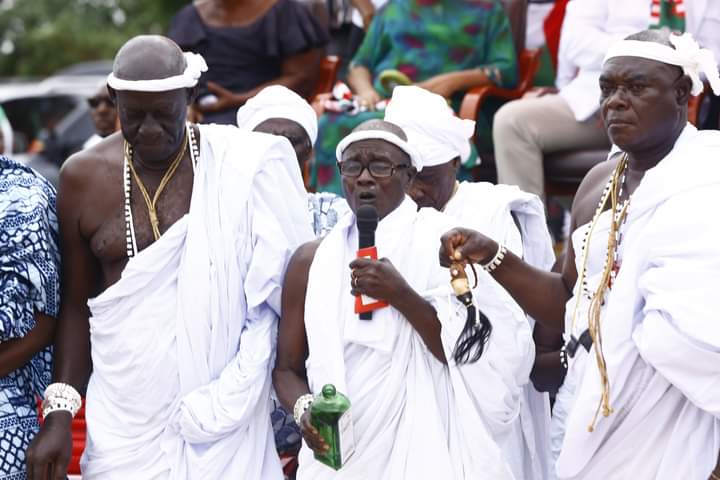
The first three High Priests (Lalue Wornor, Ngmogmlo Wornor, and Ablao Wornor) installed the fourth one (Libi Wornor) at Adibiawe Kwenya as the Priest of the Lagoon goddess – Naana Libi or Yomo (meaning Old Lady). The Libi Priesthood worship at Adibiawe Kwenya as they have no Shrine of their own.
In turn, the four of them install, at Kwenya, the fifth Priest as the Paramount King-Priest of the Ada Traditional Area, with many high- sounding titles, Among such titles are Djetse meaning Universal Father and Mekitse meaning King of Righteousness.
After the successful installation of the King-Priest the Manklalo then takes up the mantle of introduction. It is the role of the Manklalo to present the newly installed Paramount King-Priest to the people for life-long service. The Paramount King-Priest is what is now referred to as the Paramount Chief.
The current Paramount Chief of the Ada State is HRM Djetse Nene Abram Kabu Akuaku III.

These are some of the past Paramount Chiefs of Ada: Nene Ayiku Dangmlangmor, Nene Kukrantsim, Nene Akplehe, Nene Koranteng I & II, Nene Akuaku I & II, Nene Adjovu I & II, Nene Akrofi among others.
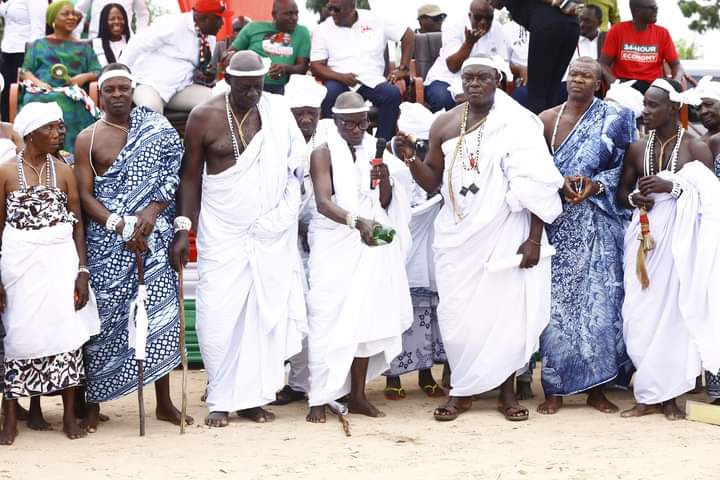
The identity of the people of Ada is closely connected to their spirituality. The four high priests traditionally dress in white cloth and beads. The Okor clans also observe certain taboos, including avoiding gold and the color red. However, some ‘Okor’ gates wear gold today because other families and groups joined them over time which are the Akan and the Ewe groups.
Other non-Okor clans also maintain distinctive cultural traits that reflect their origins also contributing to the identity and unity of the Ada State.
The Okorli migrated from Lorlorvor and settled at Okorhuem (Okor Forest). Over time, they accepted other groups into the growing Ada community. Among these were Akan groups later known as Kabiawe, as well as Korgbor, and Ohuewem, Kudrazgbe, whom they met along the riverbanks. Together, these groups eventually formed the Ada State.
The Ada State has 10 clans in general, Namely: Adibiawe, Lomobiawe, Terkpebiawe, Dangmebiawe, Ohuewem, Korgbor, Kudzragbe, Kabiawetsu, Kabiaweyumu and Kpono.
All the above mentioned clans have their Divisional Chiefs (Wetsoyihi) in addition to their respective Wornorhi (Traditional Priests) and Asafoatseme (Clan Warlords) to support the paramount stool.
Today all 10 clans of Ada are one, they are all referred to as Okorli.
Dangme is the language of the Ada people, and its principal speakers were originally the Okorli. Over time, groups such as the Kabiawe and the Ewe groups gradually abandoned their language and adopted Dangme. Although Ewe is still spoken in some parts of Ada especially among communities along the river and on the islands Dangme remains the dominant language.
The ancestors of Ada were powerful, united, formidable people and they were known for their strength, courage, unity, and military prowess. Their warriors were victorious in every battle fought in defence of their people and homeland. Hence, their neighbouring Ewe-speaking communities referred to them as Adawo (“warriors”) and called their language Adawogbe (“the language of the warriors”).
The notable traditional music and dances of the people of Ada are: Atupani, Kete, Kpatsa, Kini, Agbozo, Soweto, Lafa, Madedji, Ongorman, Awa, Gbekor among others.
Ada has a rich Cultural Heritage & Eco Tourism Destinations from Nkyimkyim Museum, named after the Akan Adinkra symbol “Nkyinkyim,” meaning “twisted” or “intertwined,” the museum embodies the complex journey of African peoples through history.
The museum is the Ancestor Project built by a Ghanaian artist and activist Kwame Akoto-Bamfo featuring over 3,500 clay head sculptures representing individuals who were enslaved and taken from Africa during the transatlantic slave trade.
To the wild encounters at Crocodile Island, the seaside delights of Rum & Clams Island, to the fascinating Salt Mining Sites, and a serene boat cruise on the Volta Lake.
RTOMedium… Be Informed… Get Informed