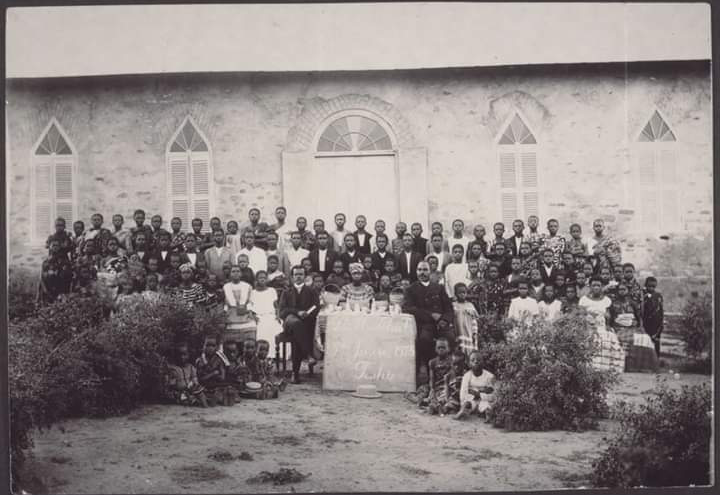
History Lane: Pupils & Teachers of Teshie Presbyterian School, Salem 1913
Pupils and Teachers of the Teshie Presbyterian School pose in front of the Presbyterian Church after church service at Salem – Teshie, Ghana. 8th June 1913
SALEM (Christian quarters): Salem is a word of Hebrew origin, meaning “peace”
A section of town inhabited by the European Christian missionaries of the Basel Mission (now Presbyterian Church) and African Christian converts.
Established in Gold Coast (Ghana) towns like Osu, Akropong, Abokobi, Peki, La, Teshie, Odumase, Big-Ada, Kyebi, Abetifi, Nsaba, Anum among others.
SALEM OBJECTIVES:
In order to build a good relationship with the indigenous Christian converts, the Basel Missionaries established these Christian communities known as ‘Salem’.
Under this policy, where missionary stations and schools were built.
Converts were required to move out of their traditional homes and settle in the ‘Christian quarters’ or ‘Salems’ on the outskirts of the community.
In the Salems, these converts could be well-monitored to grow in their faith.
The objectives of this policy were to: produce ‘refined’ Native Christians, whose conduct and lifestyle would become beacons to their unconverted families and friends as well as to make pastoral care easier for the missionaries.

In view of the above, Christian converts were subjected to strict disciplinary action to ensure there were no deviations from church regulations.
It should be noted that, even though the Missionaries had good reasons for what they did, it eventually resulted in the separation of the Christian converts from their kith and kin, thus, creating a cleavage in the community.
It did serious harm to the Africans in the sense that Africans live a communal life.
It also undermined the authority of traditional rulers and family elders.

Credit:
Annan Ashirifie Odehe-Bi/Wikipedia