History Lane: Meet Sarah Breedlove a.k.a Madam C. J. Walker, first child born into freedom after slavery
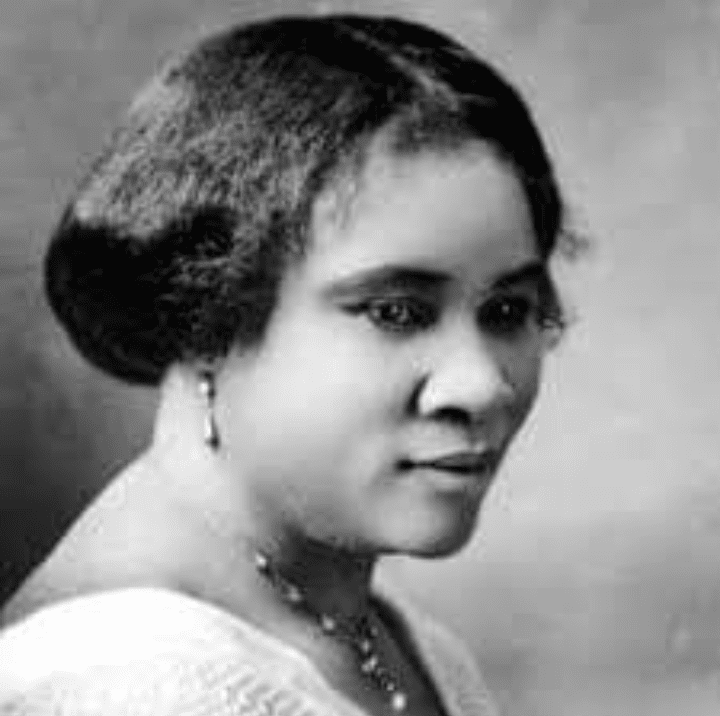
Sarah Breedlove a.k.a Madam C. J. Walker (December 23, 1867 – May 25, 1919), Born near Delta, Louisiana, USA.
Whilst her parents and her elder siblings were enslaved, Sarah was the first child in her family born into freedom after the Emancipation Proclamation was signed.
Orphaned at the age of seven, she moved to Vicksburg, Mississippi, USA and worked as a domestic worker at the age of ten.
In 1882 at fourteen, Sarah married Moses McWilliams who she had a daughter with.
In 1888 Sarah and her daughter moved to Saint Louis, Missouri, where three of her brothers lived and found work as a laundress, barely earning more than a dollar a day, she was determined to make enough money to provide her daughter with a formal education.
Sarah experienced severe dandruff and other scalp ailments, including baldness, due to skin disorders and the application of harsh products, other contributing factors to her hair loss included poor diet and illnesses.
Initially, Sarah learned about hair care from her brothers, who were barbers in Saint Louis.
She became a commission agent selling products for Annie Turnbo Malone, an African American hair-care entrepreneur and owner of the Poro Company.
While working for Malone, Sarah began to adapt her knowledge of hair and hair products to develop her own product line.
In July 1905, Sarah and her daughter moved to Denver, Colorado, where she continued to sell products for Malone and develop her own hair-care business.
Following her marriage to Charles Joseph Walker in January 1906, she became known as Madam C. J. Walker and marketed herself as an independent hairdresser and retailer of cosmetic creams; Sarah sold her products door to door, teaching other black women how to groom and style their hair.
In 1910 Sarah relocated her business to Indianapolis, where she established the headquarters for the Madame C. J. Walker Manufacturing Company, she built a factory, hair salon, and beauty school to train her sales agents, and added a laboratory to help with research.
Many of her company’s employees, including those in key management and staff positions were women.
By 1917 the company claimed to have trained nearly 20,000 women. Dressed in a characteristic uniform of white shirts and black skirts and carrying black satchels, they visited houses around the United States and in the Caribbean offering Walker’s hair pomade packaged in tin containers.
Walker became even more widely known by the 1920s as her business market expanded beyond the United States to Cuba, Jamaica, Haiti, Panama, and Costa Rica.
In addition to training in sales and grooming, Sarah showed other black women how to budget, build their own businesses, and encouraged them to become financially independent.
In 1917, inspired by the model of the National Association of Colored Women, Sarah began organizing her sales agents into state and local clubs, the result was the establishment of the National Beauty Culturists and Benevolent Association of Madam C. J. Walker Agents (predecessor to the Madam C. J. Walker Beauty Culturists Union of America.
She also rewarded those who made the largest contributions to charities in their communities.
After relocating to New York, Sarah became more involved in political matters, she delivered lectures on political, economic and social issues at conventions sponsored by powerful black institutions.
During World War I, Sarah was a leader in the Circle For Negro War Relief and advocated for the establishment of a training camp for black army officers.
In 1917 she joined the executive committee of New York chapter of the National Association for the Advancement of Colored People (NAACP), which organized the Silent Protest Parade on New York City’s Fifth Avenue, the public demonstration drew more than 8,000 African Americans to protest a riot in East Saint Louis that killed thirty-nine African Americans.

Profits from Sarah’s business significantly impacted contributions to her political and philanthropic interests.
In 1918 the National Association of Colored Women’s Clubs (NACWC) honored Sarah for making the largest individual contribution to help preserve Frederick Douglass’s Anacostia house.
Sarah pledged $5,000 (the equivalent of about $86,322.99 in 2016) to the NAACP’s antilynching fund. At that time it was the largest gift from an individual that the NAACP had ever received.
Sarah bequeathed nearly $100,000 to orphanages, institutions, and individuals; her will directed two-thirds of net profits of her estate to charity.
“I am a woman who came from the cotton fields of the South. From there I was promoted to the washtub. From there, I was promoted to the cook kitchen. And from there, I promoted myself into the business of manufacturing hair goods and preparations. I have built my own factory on my own ground” – Sarah Breedlove a.k.a Madam C. J. Walker
Credit: Annan Ashirifie Odehe-Bi