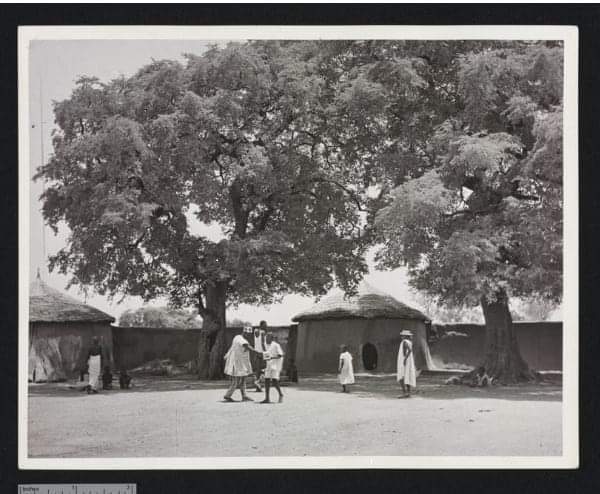
History Lane: A caravan-serai built for travellers 1945
A caravan-serai built for travellers by the Native Administration in Navrongo, Ghana, (a room costed one penny per night). 1945
Navrongo is a town and the capital of Kassena-Nankana District in the Upper East Region of northern Ghana, adjacent to the border with Burkina Faso. Navrongo is the capital of Kassena-Nankana District – which is within the Upper East Region of northern Ghana. Navrongo has a 2012 settlement population of 27,306 people.
Navrongo is an important market town, known for its cathedral and its grotto. Navrongo is located at 10°53′5″N 1°5′25″W. The terrain is flat and the ecology is typical of the Sahel – arid grassland with occasional shrubbery.
The first ever Solar Plant with a capacity of 2 Megawatts in Ghana is located at Navrongo: Navrongo Solar Power Station.
The town was founded around 1740 by Butu, a Nankane speaking hunter from Zecco (present day sourthern Burkina Faso), who initially settled in Pungu (a Kasem speaking community further south of Zecco). During the 19th century, the town became an important staging post on the Sahel caravan route. At the beginning of the 20th century the British established a base at Navrongo.

A Catholic mission was established in 1906 – the White Fathers (“Pères Blancs”), a French group made up of French Canadians. They came to Upper East region from Upper Volta (now Burkina Faso) due to French anti-clerical laws (the Fathers believed they would be expelled from Upper Volta).
The British allowed them to set up in Navrongo on condition that the school that they were to establish used English only. Despite a rocky beginning (the Fathers had learnt the wrong local language and only attracted 5 students in the first 18 months), the school eventually became a success – a British official in 1927 said that it was the best school (of only 5) in the north of Ghana.
Subsistence level agriculture is the usual economic occupation of Navrongo, as well as the rearing of goats and cattle.
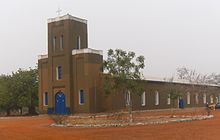
Navrongo Cathedral, as it is now known, was built in 1906 and expanded in 1920. Originally called “Our Lady of Seven Sorrows”, the construction was overseen by the White Fathers. The walls are of mud (therefore it is also called “Mud Cathedral”), and wooden beams form the roof. On the inside, the walls are decorated with animal forms, scenes of everyday life, and Christian themes such as the Last Supper and the Bethlehem scene in the entrance area. The site also contains a grotto and accommodation facilities.
The word “Navrongo” is an Anglicization of the name navrongo which is in Nankane, which combines the word naare (meaning foot or leg in Nankane) with vorongo (the term given to the sound of stepping onto muddy soil) or “voro” which is the Kasem term for same. This is why Kasena call the town “Navoro” while Nankana call it “Navorongo.”
Credit: Annan Ashirifie Odehe-Bi, Wikipedia