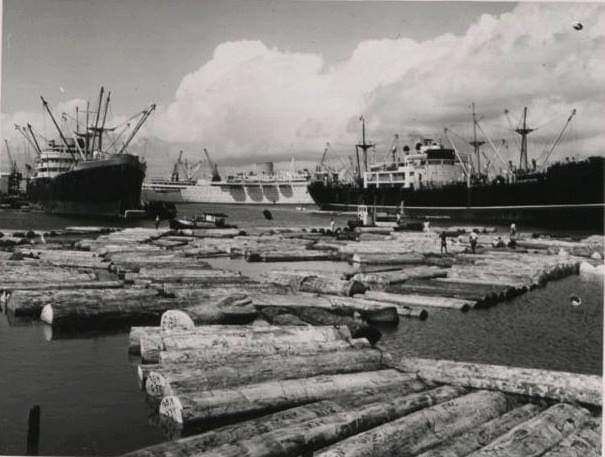
History Lane: Timber logs awaiting shipment 1957
Timber logs awaiting shipment at Takoradi Harbour, Ghana. 1957
Takoradi also an Ahanta town was the site of Dutch Fort Witsen (1665) and has an important deepwater seaport, Ghana’s first, built in 1928.
Takoradi houses the Harbour and has timber, energy and technology industries. Over the years it has attracted a good number of investors, including miners, as the city is close to the mining towns in the western part of Ghana. Ghana’s recent discovery of oil gave the Sekondi-Takoradi township to be known as the Oil City.
During World War II, RAF Takoradi was an important staging point for British aircraft destined for Egypt. Spitfire fighter planes were shipped in crates from England to Takoradi where they were assembled then flown via Nigeria and Sudan to the war in Libya.

26 Squadron SAAF was also based in Takoradi during World War II flying anti-submarine and convoy protection patrols over the Atlantic. A number of South African airmen are buried in the Takoradi European Public cemetery.
The city is currently named (although not officially) as the Oil City of Ghana due to the massive discovery of oil in the Western region and has attracted massive migration from people all around the world.
For example, of the 248,680 people in the Sekondi-Takoradi metro area in 2010, 148,000, or well above half were indigenous Ahanta people, 30,000 came from the central region of Ghana, 60,000 are from other regions of Ghana and 10,000 are foreign nationals.
Credit: Annan Ashirifie Odehe-Bi, Wikipedia