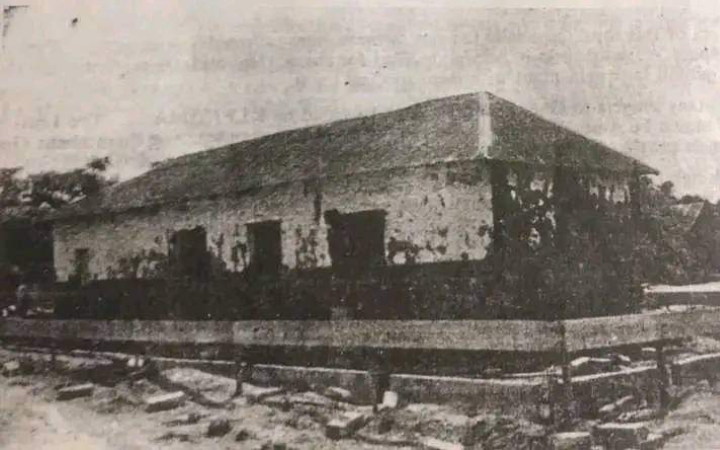
History Lane: The first ARS Chapel built-in 1940
The first ARS Chapel at Tadzewu, built-in 1940.
The Apostles’ Revelation Society (ARS) is an African Independent Church (AIC) and the first church to accept African Baptismal names, African greetings, African clothes, African music and dance and myriad African values and customs against conventional Christian theology of the time.
The church founded by
Prophet Charles Korblah Nutornutsi Wovenu (Prophet C.K.N Wovenu) is at Tadzewu in the Volta Region of Ghana where its Head office is located.
Tadzewu (Tadzevu) is a town located in the Ketu North Municipal District of the Volta Region in Ghana, situated between Akatsi and Dzodze.
Prophet C.K.N Wovenu was born in a small village called Anyako in the Volta Region of Ghana in West Africa. His parents were Mr. Mutorntsi Kluvia and Mrs. Mikayanawo Dzakpata (He was the only child to her mother). He was born in the year 1918 after the First World War.
He started his elementary education at Adxoun in Togo and continued in Ghana at Anyako since his mother died in 1932 and later was catered for by a relative Mr. Joseph P. Attipoe at Akuse in Ghana. He was employed as a warder in the prison service in 1935 at Akuse but later resigned from the prison service after one year service.
He also worked with the Consolidated Africa Selection Trust (CAST), a diamond prospecting
company in Akwatia… Because of sincerity and faithfulness, he was posted from chemical ranks to supervisor.
After a short stay at Anyako, in November 1st 1939, he moved to Tadzewu where he commenced
his desire missionary work. He initially voluntarily affiliated with the Ewe (now Evangelical) Presbyterian Church. The prophet certainly improved by God for his ministerial ministry. The
power of God was so great in him that he was able to perform many miracles: curing all manner of disabilities and abnormalities. He made cripples walk, he showed benevolence towards the needy,
the poor, the destitute, the afflicted, the despaired and other in helpless states were unparallel.
The prophet established free institutions to enable everybody to have equal access to educate or vocational training. Most of the institutions were later absorbed into Ghana Education Service.
Prophet C.K.N. Wovenu did not have any tertiary education yet he impressed and astounds many people with his astute knowledge of the scriptures. In spite of all the persecutions, he was able to transform and convert the remote pagan village to Tadzewu into a modern Christian worship. He linked it surrounding towns and villages with roads e.g. Akatsi, Devogo, Dzodze, Xevi and Abor all in the Volta region in Ghana.
He provided the communities with Post Offices, Police station,
electricity, portable drinking water, he commenced good housing scheme and heavily centre.
In 1940 the prayer group received in a revelation the name Apostles’ Revelation Society. Seventeen principal officials bearing the title of Apostles run the Church. Below them are Regional Superintendents, Ministers, district and station pastors.
The church leaders, especially the founder, were renowned for their prophetic ability, healing and spiritual guidance to members. They also extended these spiritual resources to communities and groups that sought the guidance of the Church.
In addition to the normal Christian sacraments, the ARS instituted additional ones, that sanctify traditional African practices. These include sacraments of insurance and protection for pregnancy, maidenhood, children, marriage and property. There are also foundation rites for putting up buildings, and acquiring the spirit of one’s profession, etc. Many traditional rites of passage such as the outdooring of children, rites for twins, widowhood rites and the installation of traditional chiefs have been Christianized in the ARS.
The Church uses both Old and New Testament as the full basis of its faith and worship with the Old Testament providing the basis of ARS culture. It also promotes traditional culture in a Christian way. For instance it has rules and codes of behaviour for its members as found in many AICs. Its code of conduct includes abstention from alcohol, worshipping barefoot, regular periods of fasting, and a dress code for the leadership. It also practises animal sacrifices. One of the purposes of a sacrificed sheep is to bring life and cleanliness to the individual and society. Also the sacrifice of coconuts, honey, and salt as burnt offering are meant to bring their sweet flavour into one’s life.
ARS liturgy is rich in African imagery and symbolism. It incorporates forms of singing with drums and African musical instruments which are adapted to scriptural lyrics. The Lord’s Prayer for instance is set to Anlo Ewe songs.
ARS has liturgy for many African events such as outdooring, and naming of children, the birth of twins, widowhood rites, elevation to traditional leadership, etc. Major celebrations of the Church include all Christian celebrations and a special end of year Anniversary Celebration, as well as a Founders’ Day and Marriage Day. There are associations within the Church including a welfare group and an Associations of Traditional Chiefs, which is unique to the ARS.
The Church also encourages development in communities in which congregations are established. In addition to New Tadzewu, which serves as the Headquarters of the Church, the Church also developed four other new townships. It has established over fifty schools. The leader is also credited with the establishment of important markets in the Volta region thus boosting economic activity. It also promotes the provision of public conveniences and clean water for drinking. Members are themselves exhorted to hard work and to abjure laziness.
Though membership is drawn predominantly from the Ewe ethnic group, the Church has grown to embrace Akans and other Ethnic groups along the West Coast from the Ivory Coast to the Republic of Benin. ARS has around 638 branches in Ghana and several international branches in Canada, USA, England, Holland, Germany, France, and Belgium.
In July 1943, He added the name Wovenu (meaning ‘one who has received grace’) to his names.
In 1944 the movement came into conflict with the Ewe Presbyterian Church over Wovenu’s spiritual practices, as well as the administration of a grant of money to the school he founded, from the colonial District Commissioner.
The great Ewe poet Hesinor Vinorko Apaloo Akpa converted and joined the ARC in 1964 bringing into the Church his rich repertoire and gift in traditional composition.
Prophet C.K.N Wovenu died on 10 April 1999, and was succeeded by Apostle Amega.
RTOMedium… Be informed… Get informed



Hi, dear brother in the faith. Should I say am lucky? No am blessed to have found your write up on the net after tons of hours spent searching for the legacy of the Man of God. You have done a great job, God bless you. My name is Dominic, a grandson of the Prophet currently residing in Tadzewu, the HQ. A new book is out about the prophet written by his nephew Sam Nutornutsi in which there are many awe inspiring things publishm The book is titled: God’s Miracles through Prophet CKN wovenu. Would be glad to connect with you so we can collaborate in any way possible to get posterity to know of what God has done. I am Dominic, nice meeting you.
Great 🙏🏿🙏🏿🙏🏿, you can send a mail to rastbcofoe@gmail.com, so we connect.