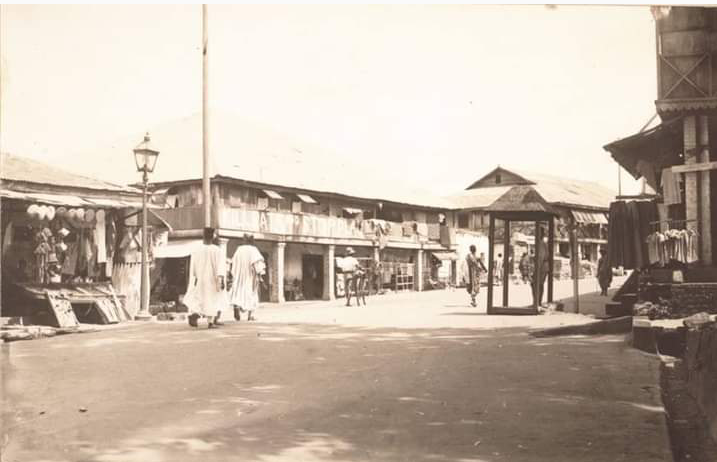
History Lane: Street scene, Kumasi 1925
Street scene, Kumasi, Ghana. 1925
Kumasi is a city in the Ashanti Region, and is among the largest metropolitan areas in Ghana. Kumasi is located in a rain forest region near Lake Bosomtwe, and is the commercial, industrial and cultural capital of the historical Ashanti Empire. Kumasi is approximately 500 kilometres (300 mi) north of the Equator and 200 kilometres (100 mi) north of the Gulf of Guinea.
Kumasi is alternatively known as “The Garden City” because of its many species of flowers and plants in the past. It is also called Oseikrom (Osei Tutu’s town).
Kumasi is the second-largest city in Ghana, after the capital, Accra.
The Central Business District of Kumasi includes areas such as Adum, Bantama, Pampaso and Bompata (popularly called Roman Hill), with a concentration of banks, department stalls, and hotels.
Economic activities in Kumasi include financial and commercial sectors, pottery, clothing and textiles. There is a significant timber processing community in Kumasi serving the domestic market. Bantama High Street and Prempeh II Street in Bantama and Adum, respectively, are the business and entertainment hubs in Kumasi.
The name derives from the Twi language, meaning ‘under the Kum tree’. The word “ase” or “asi” means ‘under’, ‘down’ or ‘below’, and is used in many place names in Ghana, such as Obuasi, Daboase, and Kenyasi.
Around the end of the 17th century, the Ashanti Kingdom’s chief fetish Priest, Okomfo Anokye planted three kum trees at different places: one at Kwaaman, ruled by the Nananom Ayokofuo; a second one at Apemso-Bankofo, ruled by Nananom Aduanafuo; and a third at a village near Fomena and Amoafo called Oboani, which was ruled by Nananom Ɛkoɔnafuo. Komfuo wanted to see which of these would become a great city for the kingdom, as he was directed by the oracles.
The kum tree at Kwaaman flourished so vigorously that the King and his people often sat underneath, and so Kwaaman became Kum-ase, meaning ‘under kum’.
The tree at Oboani was, however, very tiny and for no apparent reason was relatively short.
According to oral tradition, this small tree produced other trees which were all small in size. The name of the village was changed to Kuma, meaning ‘small kum’.
The kum tree at Apemso-Bankofo did not grow at all. After a few weeks the leaves rotted and the tree fell down; so it was said that the village’s kum tree was dead, and the village became Kum-awu, later Kumawu.
The city features a tropical wet and dry climate, with relatively constant temperatures throughout the course of the year. Kumasi averages around 1400 mm (55″) of rain per year.
The city almost features two rainy seasons: a longer season from March through July and a shorter rainy season from September to November.
The months of February through to November is one long wet season, with a relative lull in precipitation in August. Similar to the rest of West Africa, Kumasi experiences the harmattan during the “low sun” months. Lasting from December to February, the harmattan is the primary source of the city’s dry season.
Credit:
Annan Ashirifie Odehe-Bi/Wikipedia

Please subscribe to our website for updates by clicking on the red bell 🔔 on your left.