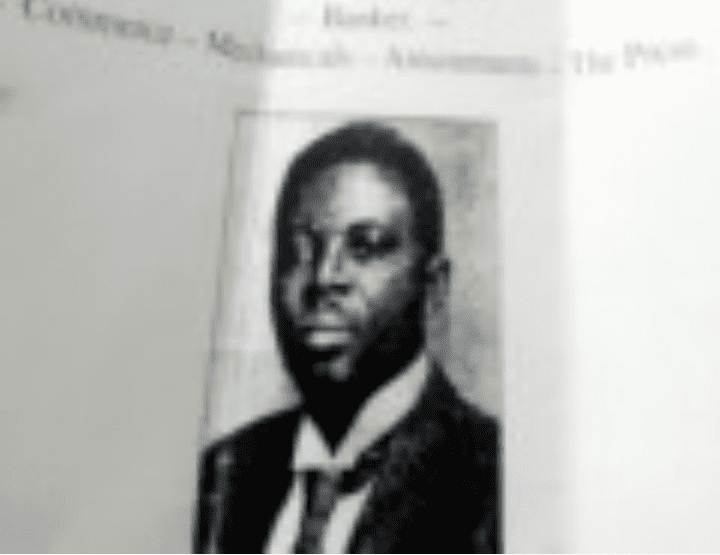
History Lane: Meet A.J.K Ocansey, The first African to build a Cinema house
Alfred John Kabu Ocansey, born on December 14, 1879, at Ada to John Episi Ocansey and Salome Korngo Ocansey. He passed away on September 1943 at Accra.
He was an investor in four key areas of media namely; newspapers, the cinema, radio and musical as well as sound equipment and facilities.
He was the first to import and sell gramophones and radio receiver sets in the Gold Coast, which were still a novelty in Europe and America.
As a nationalist, businessman and media mogul, he financed and sponsored many national and international events in the quest for freedom for the Gold Coast.
He was the first African to build a Cinema house in the year 1925 which he named after the London Palladium following his own visit to the venue. The Accra Palladium Cinema, situated directly opposite the Wesley Methodist Church at Jamestown.

Audience paid to watch silent films which were exhibited by Ocansey using a hand-cranked projector. Audience were actively engaged during the film screenings sessions through loud reactions and commentary. They would urge the operator to crank the projector faster during a fight scene or a chase sequence.
Through these viewing sessions terminologies like ‘killer’ and ‘Jack’ emerged. ‘Killer’ was always used for the villain whilst ‘Jack’ was used to refer to the protagonist in every film, who was an intelligent, strong character who always over powered the villain at the end of the film.
Other terminologies also emerged; for instance when the protagonist, villain or the main character in the film was killed, people would rise to leave and did not wait for the narrative to end; they made statements like, “Jack yaa mutu, cine yaa kaare,” the Hausa language meaning “If Jack is dead then the film is over”. Such statements were made by some West African immigrants in some communities in the Gold Coast.
He also built a chain of cinemas in major cities in the Gold Coast.
Alfred Ocansey later employed gramophone sounds to accompany the silent films screening and by 1933 when colour film was introduced to cinema, Ocansey didn’t hesitate to take that opportunity to its fullest in the film exhibition business.
It is said that Ocansey’s closest competitor at the time was John Holt Bartholomew, a British Merchandising Company that used a portion of its premises to show films to paying audiences.
Ocansey used a gramophone to provide sound for the silent films while Bartholomew theatre employed an organ player; provided music before the film screening.

Aside these two pioneers, there were various film exhibitors who moved from one village or town to next around the country.
These exhibitors would hire large walled compounds of large homesteads and charge entrance fees.
Though Ocansey possessed the largest chain of film theatres thus having a monopoly of film distribution at that time; it is unclear why it did not develop into a more structured business of film distribution in Ghana.
Despite the significant roles individual business men played in commercial film distribution and exhibition, it was the colonialist who controlled film production in the country and they reached onto to a larger number of audiences in diverse towns and villages across the country.

RTOMedium …be informed …get informed