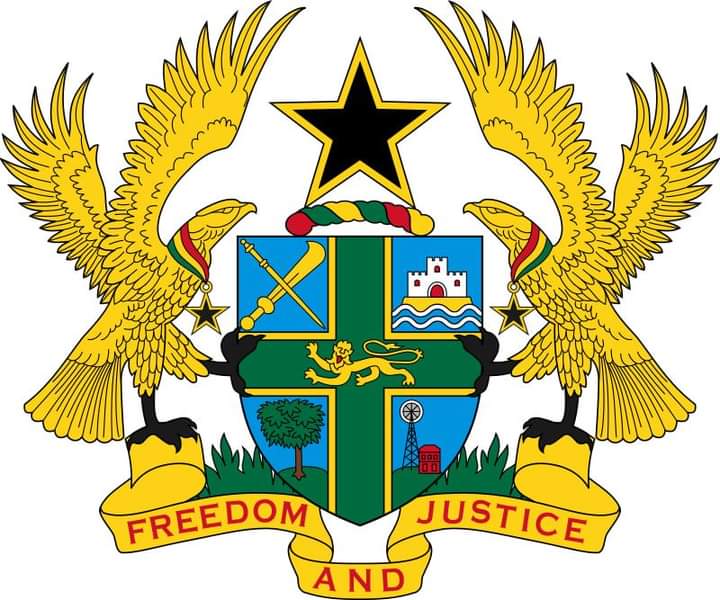
History Lane: The coat of arms of Ghana, break down and description.
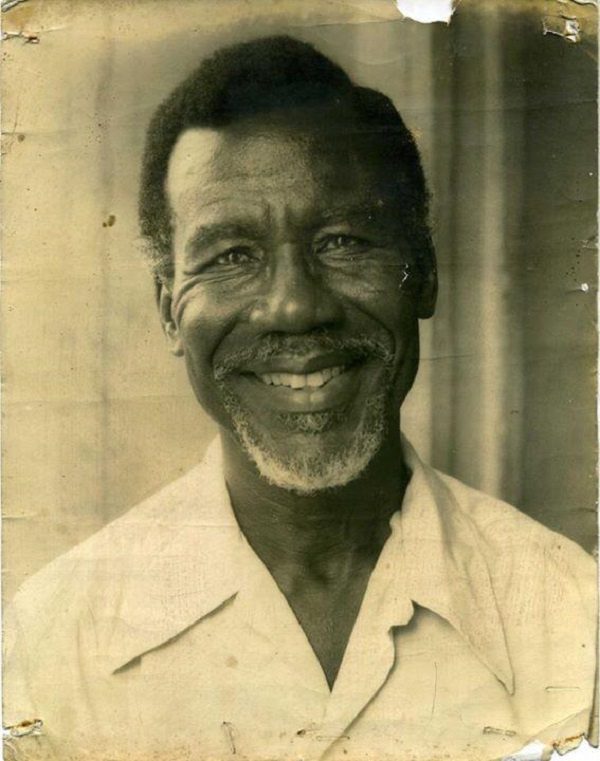
The coat of arms of Ghana was designed by Ghanaian artist Amon Kotei.
He was commissioned to do the design it by Ghana’s first President Osagyefo Dr. Kwame Nkrumah and the then-British colonial administration as independence drew near in 1957. It was introduced on 4 March 1957.
Break down:
Azure on a cross vert fimbriated Or a lion passant guardant Or,
In the first quarter a linguist’s staff and ceremonial sword crossed in saltire Or,
In the second quarter issuant from five bars wavy Argent and Azure a castle Argent upon a mount Or,
In the third quarter affixed in a grassy plain a cocoa tree proper and in the fourth quarter upon a grassy plain a mine proper.
Two eagles displayed Or around each of whose neck hangs a black star fimbriated Or suspended from a ribbon tierced gules, Or and vert upon a grassy compartment proper.
Motto: Freedom and Justice
Description:
The first quarter, on the upper left shows a sword used by chiefs, and a staff, used by the linguist (known as an okyeame in Akan), at ceremonies. It is a symbol for the traditional authority of Ghana.
The second quarter shows a representation of Osu Castle on the sea, the presidential palace on the Gulf of Guinea, symbolizes the national government.
The third quarter of the shield shows a cacao tree, which embodies the agricultural wealth of Ghana.
The fourth quarter shows a gold mine, which stands for the richness of industrial minerals and natural resources in Ghana.
A gold lion centred on a green St George’s Cross with gold fimbriation on the field of blue, represents the continuing link between Ghana and the Commonwealth of Nations.
The crest is a Black star of Africa with gold outline, upon a torse in the national colours.
Supporting the shield are two golden Tawny eagles, with the Order of the Star of Ghana suspended from their necks.
The compartment upon which the supporters stand is composed of a grassy field, under which a scroll bears the national motto of Ghana: Freedom and Justice.
Credit: Wikipedia